
vol xI: set designer alma
Women in Motion Vol 11
Showcasing Alma Josefine Thiele
Alma’s work is about creating worlds. Sometimes they exist on a theatre stage, sometimes within the frame of a film, and sometimes in an exhibition or music video. What connects them is her interest in how spaces can carry a feeling, shape a story and change the way we experience what is happening within them.
Her path into this world was not completely straightforward. She started with architecture, found her way into theatre and film, and built much of her practice by saying yes to opportunities, learning while doing and following the projects and people that felt right.
How would you describe what you do?
I think spatial designer probably describes it best. What I find exciting about my work is how broad it is, because you can work in theatre, film or exhibitions, but in the end it is always about shaping spaces and creating a certain atmosphere.
And space can mean many different things. It can be an interior or an exterior, but it can also be understood in a broader sense, even as a social space. I think that openness is what I like about it most.
Do you remember where that interest in spaces started?
I think very early. I sometimes have this theory that, as adults, we eventually return to the things we naturally did as children. When I was young, I was always drawing spaces, imaginary houses and little worlds.
My parents recently gave me a box with old drawings, and there were all these caves and places I had invented, where I would imagine who lived there and what their surroundings looked like. So I think that interest was always somewhere inside me.
Then puberty happened, I finished school and suddenly had no real idea what I wanted to do. I took a year off and eventually reached the point where I thought, I just have to start somewhere. Architecture felt like the most logical choice at the time.
Did architecture feel like the right place for you once you started?
Not completely. I spent quite a large part of my studies with this feeling that it was not exactly what I wanted to do.
There was always this inner conflict of, I started this now, so should I finish it? Do I actually want to do this? Architecture is also incredibly time-consuming, so for a while I was caught between the degree itself and this constant question of whether it was really the right path for me.
But something very valuable happened alongside it. While studying, I slowly started building a second world for myself.
Was that when theatre first came into your life?
Yes. I think it was around my second year of university. I met a theatre director at a party, and at that point I did not even really understand what that job meant. She was working in Weimar and told me, “Alma, I have the feeling this could be the right thing for you.”
She invited me to work with her, and I spent two months in Weimar. After that, I started working in theatre during my semester breaks, and later film sets came into the picture as well.
It became a huge hustle because I was doing all of this alongside my degree, but at the same time it was incredibly fulfilling because it expanded the field I had originally entered through architecture and showed me how many other directions it could lead to.
Did you immediately feel at home in theatre?
The theatre world is a very particular cosmos, and if you have never been part of it before, it can be difficult to understand how everything works. It is a hierarchical world, as a lot of working fields are, that at first you can feel quite thrown into. Someone really taking you by the hand is god sent, because such a different language is spoken here.
I remember feeling like I was physically in the room, but in the beginning I did not really understand what people were talking about and how the social dynamics worked. That was exhausting for me because I am someone who really likes to understand the spaces I am in, not only physically but socially as well.
After those two months, we had a beautiful premiere, but I still came back to Berlin thinking, I do not know if I want to be part of this world. So for a little while, I left theatre alone.
And then film came in almost by chance?
Yes, again through someone I met. I was working in a jazz bar in Berlin called A-Trane, and I met someone there who was studying at film school.
One evening, I told him that I would really love to experience a film set at least once. Some weeks later, he told me they were about to start shooting a graduation film and asked if I wanted to join.
I spoke to the director, we met, and suddenly I was part of the project. I remember being incredibly nervous because I could feel that this might open another door for me.
What was different about that first film set?
It felt completely different. I joined as an assistant in the set design department and was involved from the beginning of the production, and what immediately struck me was how collaborative everything felt.
There were so many people working together, but it still felt very much on eye level. Everyone wanted to create something together, everyone was curious about what the others were doing, and you could really feel how one creative idea became stronger through all these different people contributing to it.
Of course, part of that probably came from it being a student film. There was less hierarchy and more room to experiment. We had shooting days that lasted thirteen or fourteen hours, and somehow people were still joking around while someone walked through the set handing out cheese toast.
Everyone was exhausted, but there was this feeling that people genuinely wanted to be there because they believed in what they were making. That energy was incredibly motivating.
Was that also the moment when you realised that you could actually do this?
Yes, and that was probably one of the most encouraging parts. On the third day, one of the cinematographers came up to me and told me he thought I was doing a really good job. Then he asked if I wanted to work on his film as well.
From there, it developed almost entirely through recommendations. Someone would work with me, pass my number on to someone else, and then another project would come along. That word-of-mouth culture is incredibly strong in this field.
You eventually returned to theatre. What drew you back?
I talked to the head of design at the Schaubühne in Berlin, explained a little about my background and said that I would love to work there. We met, and that became my way back into theatre.
I was working in a very small team and ended up covering quite a few different areas throughout the production. At times, I was assisting the director, Milo Rau.
One thing I really value about this profession is that you constantly meet very different personalities. You observe how people work, how they enter a room, how they communicate and what kind of energy they bring with them.
I think you take little parts of those encounters with you. They somehow become part of your own way of working and even part of your own identity.
What feels different about designing for theatre and film?
The biggest difference is probably the way space is seen. In theatre, you usually have a frontal situation, so the audience is sitting on one side and looking into this kind of box where everything happens.
Of course, you can change the space through projections, moving elements or different transformations, but the audience is still seeing the whole stage space as a space.
Film works very differently because you are building for the frame. Sometimes what looks like a complete room on screen is actually just one wall, a lamp and a very carefully composed camera angle. Everything outside that frame might simply be equipment, lights and twenty people standing around.
So you have to learn to think in fragments. You are not necessarily creating an entire room. You are creating exactly the part of the room that the camera needs to see, and I find that incredibly fascinating.
Has that changed the way you watch films yourself?
Completely. Once you have spent enough time behind the scenes, especially on film sets, you start watching films with a different kind of attention.
Suddenly I am thinking, That must have been incredibly difficult for the make-up department, or, How did they manage that camera movement? You start seeing all these technical decisions that you probably would not have noticed before.
Sometimes it is almost annoying because you cannot switch that part of your brain off anymore, but at the same time it gives you a much deeper appreciation for how many people and how much work are behind a single image.
Do you feel like you have to choose between theatre and film?
Right now, I feel very connected to theatre. I am really looking forward to the production I am starting at the Deutsches Theater, and at this moment it feels like the right place for me to be.
But I do not think it necessarily has to be one or the other. Film is something that can also happen quite spontaneously, and I can imagine moving between both in the future.
For now, I am leaving that completely open.
You have also worked on music videos. What do you like about them?
I love music videos. They are probably one of my favorite things to work on because it allows so much freedom.
In a narrative film, I sometimes think of set design as being a kind of midwife for the story. The story already exists, and your job is to help give it a visual and physical form.
With a music video, you can often be much more focused on atmosphere. You are there for the feeling, the aesthetic and the world around the music. It does not necessarily have to tell a clear story. It can simply create a visual language that works together with the song and becomes a kind of a “Gesamtkunstwerk”.
Because I am also very interested in music and make music myself, that intersection feels especially exciting to me.
How does a visual world like that begin?
Usually, everything starts with one idea. Someone has a song and maybe already a rough image or feeling in mind, and then the question becomes, How can we translate this visually?
From there, you start bringing people into the process. You might have someone responsible for costume, someone for make-up, set design, cinematography and, of course, the director.
Then everyone comes together and starts defining the aesthetic world of the project. For me, it is really important to make that world as clear as possible quite early on.
If we decide, for example, that the costumes are all blue, then maybe I build a yellow wall. The different departments should respond to one another, and the closer everyone works together at that stage, the stronger the final visual concept becomes.
Is there a project that you feel especially connected to?
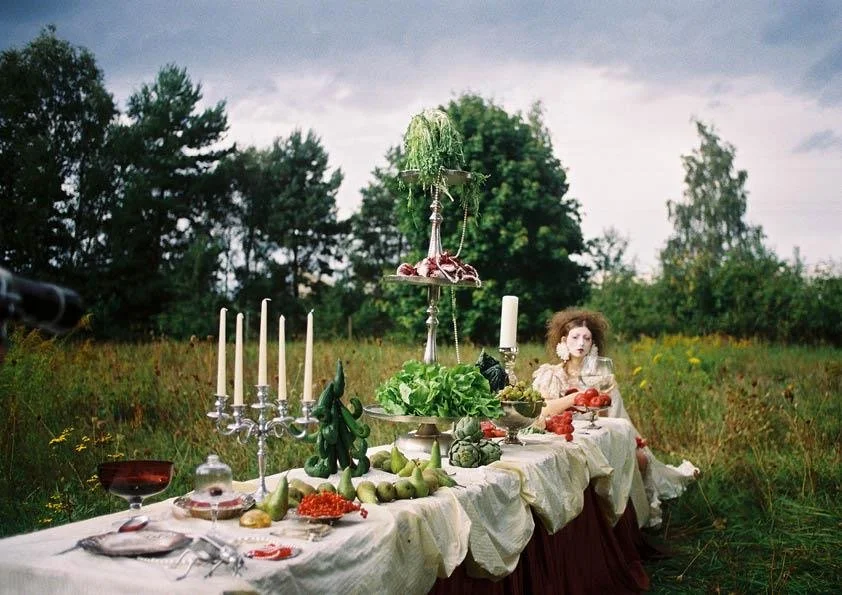
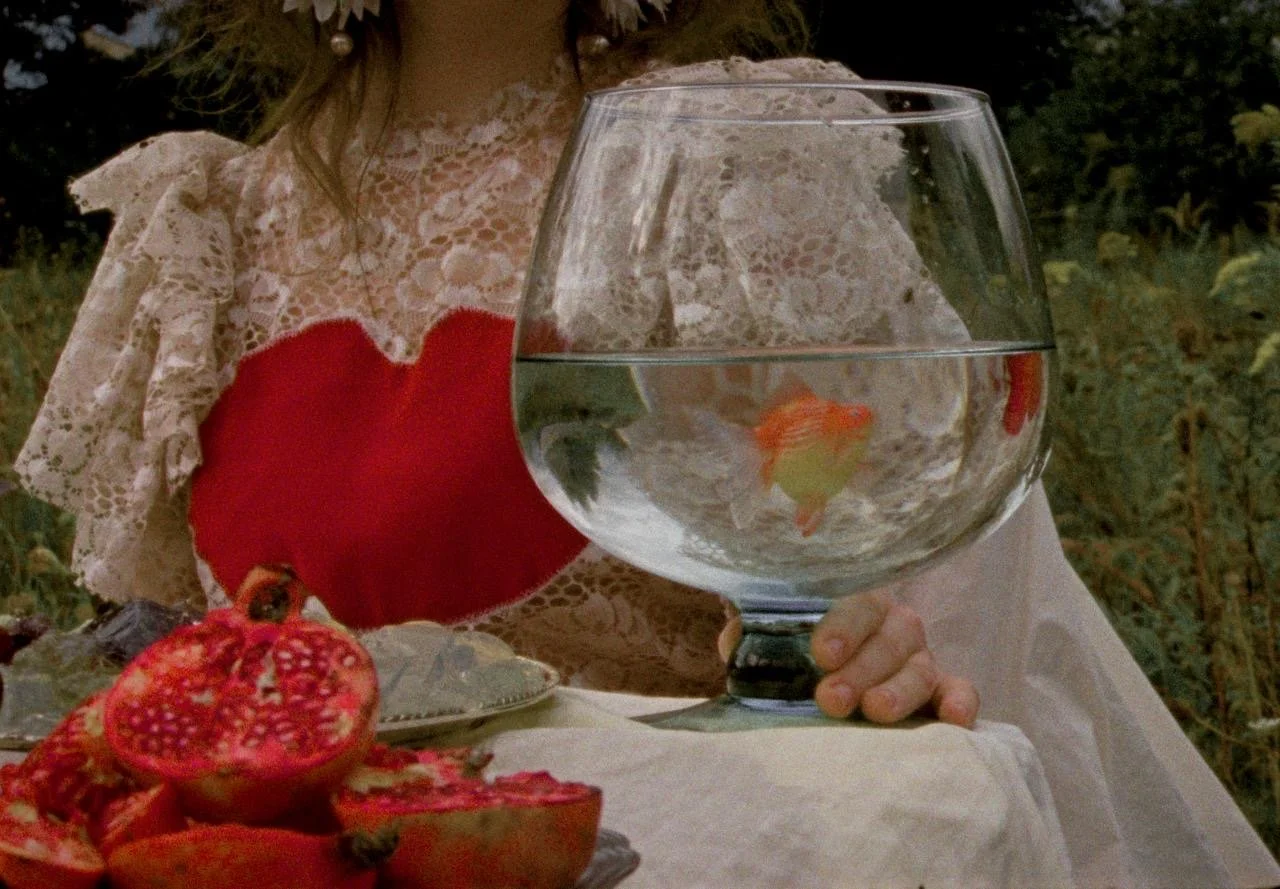
There are two film projects that immediately come to mind. One of them is Spit It Out, a music video I worked on with Lail & Lomar.
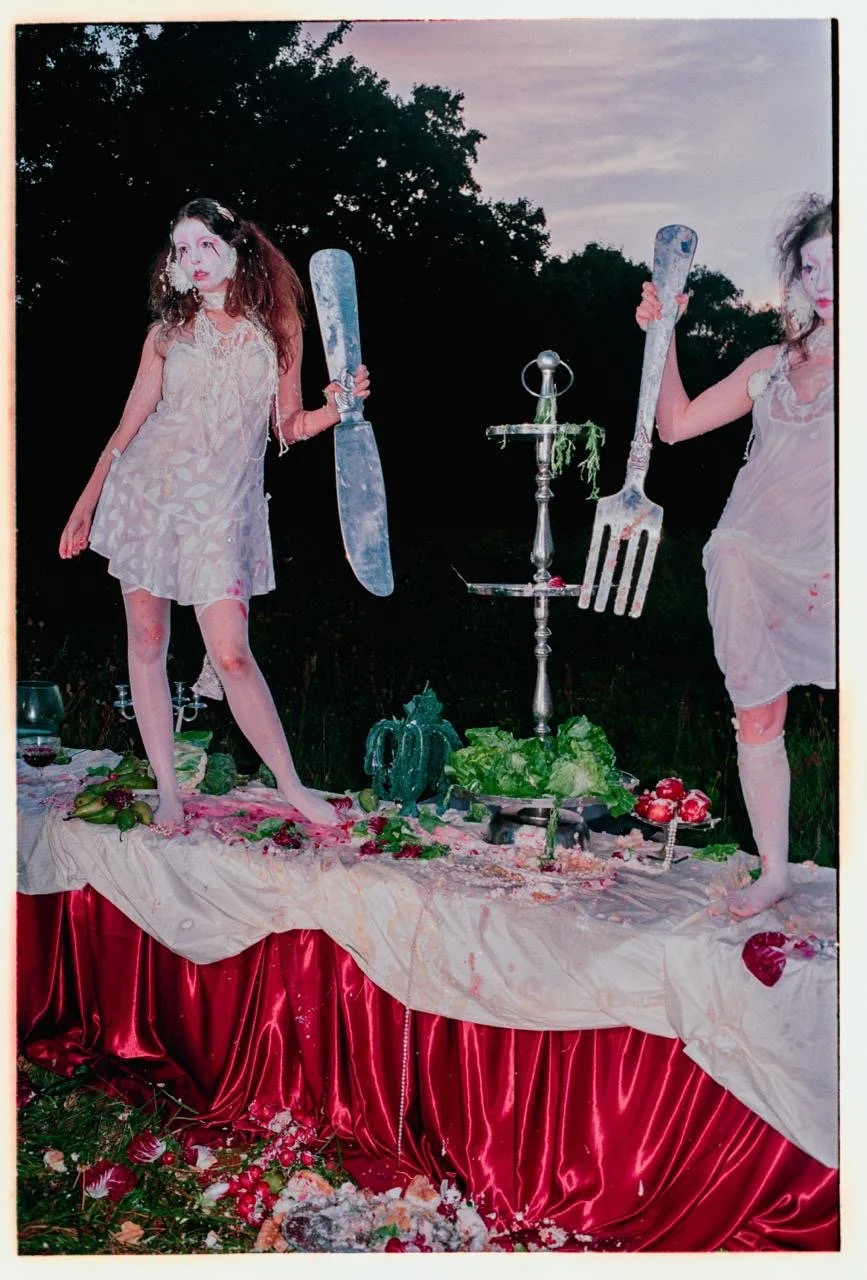
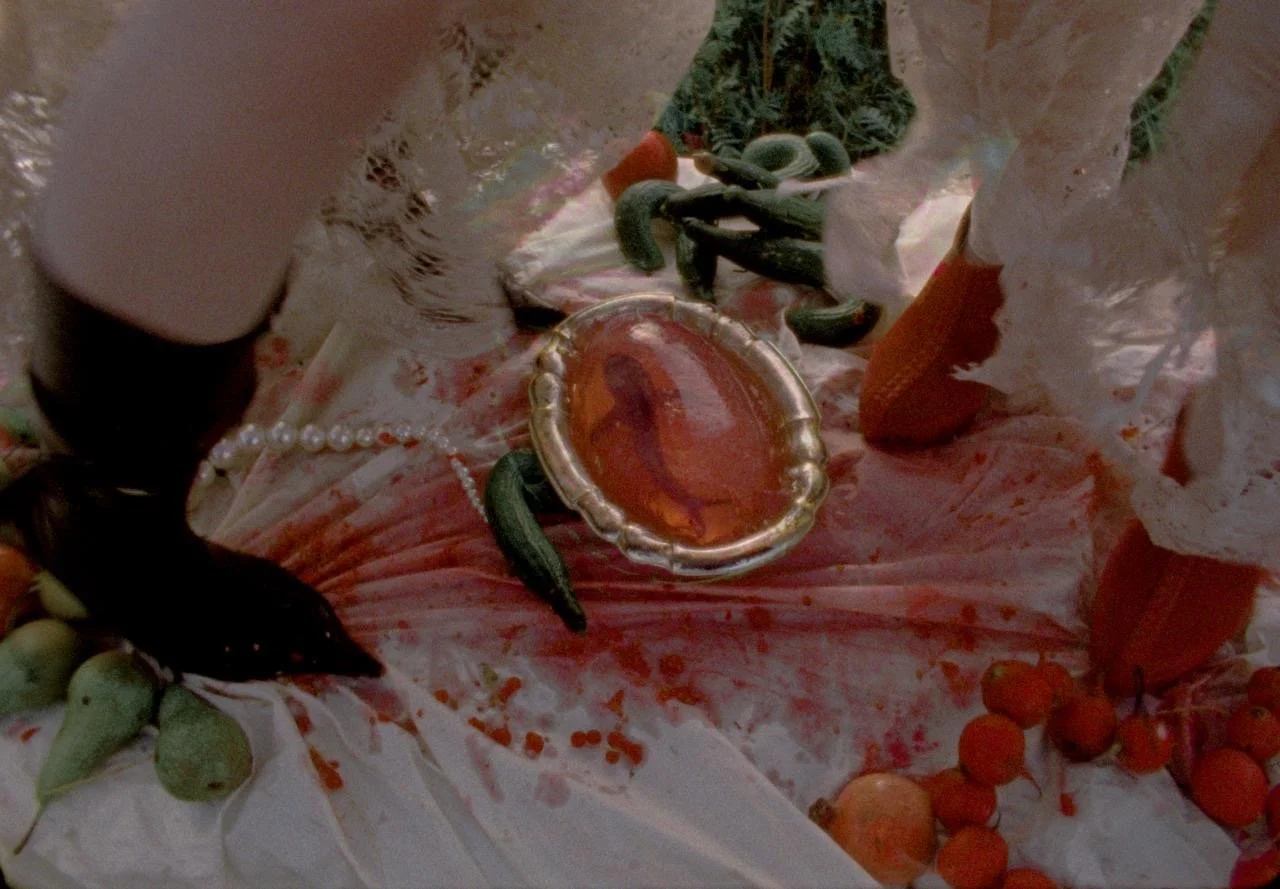
The concept was inspired by Alice in Wonderland, and once we had that idea, everything started growing from it. That is one of my favourite parts of the process, because you begin with one visual direction and suddenly start seeing ordinary objects differently.
I remember walking through a market and looking at vegetables thinking, This could look incredible on the table. A cabbage could suddenly become almost like a flower. We made a jelly cake, found strange little objects at flea markets and kept adding things that somehow belonged to this world we were creating.
At some point, you become completely absorbed in it.
Was there another project that stayed with you?
Yes, another music video, this time for the Vianova Choir in Munich.
I got asked about a week before the shoot while I was on holiday in Italy, so it was all very spontaneous. Then they told me something that is basically every set designer’s dream: there was a prop warehouse in Hamburg and I could choose whatever I wanted from it.
Usually, you are constantly thinking about the budget and asking yourself what is actually possible. This time, they basically said, We have two vans. Take what you need.
So of course I said yes.
What kind of world were you creating for that video?
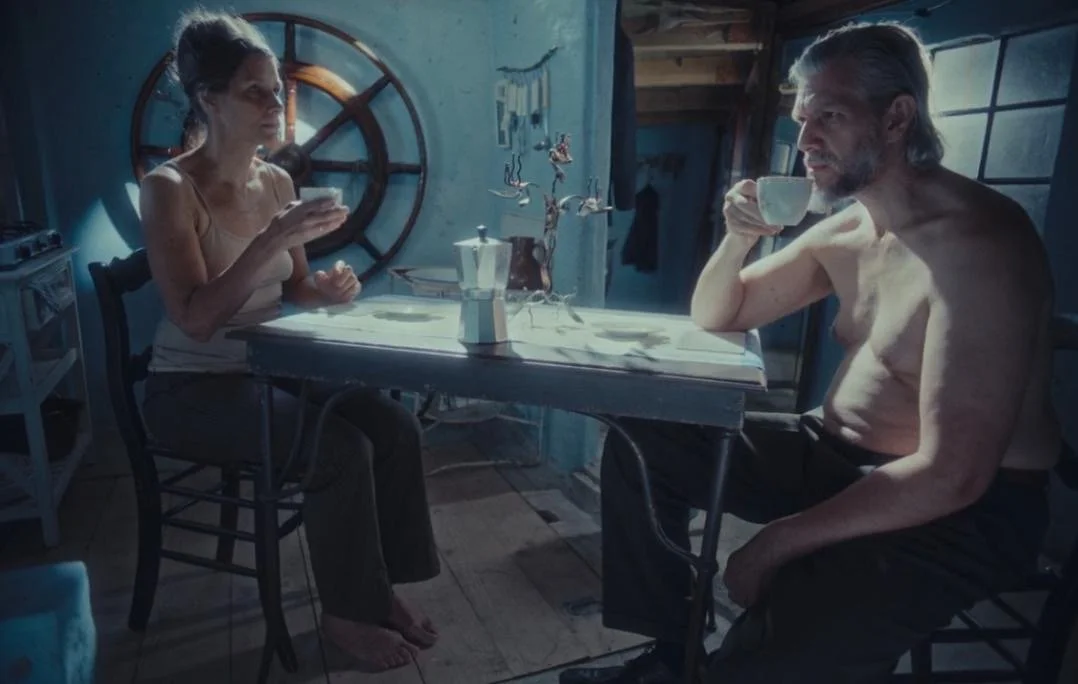
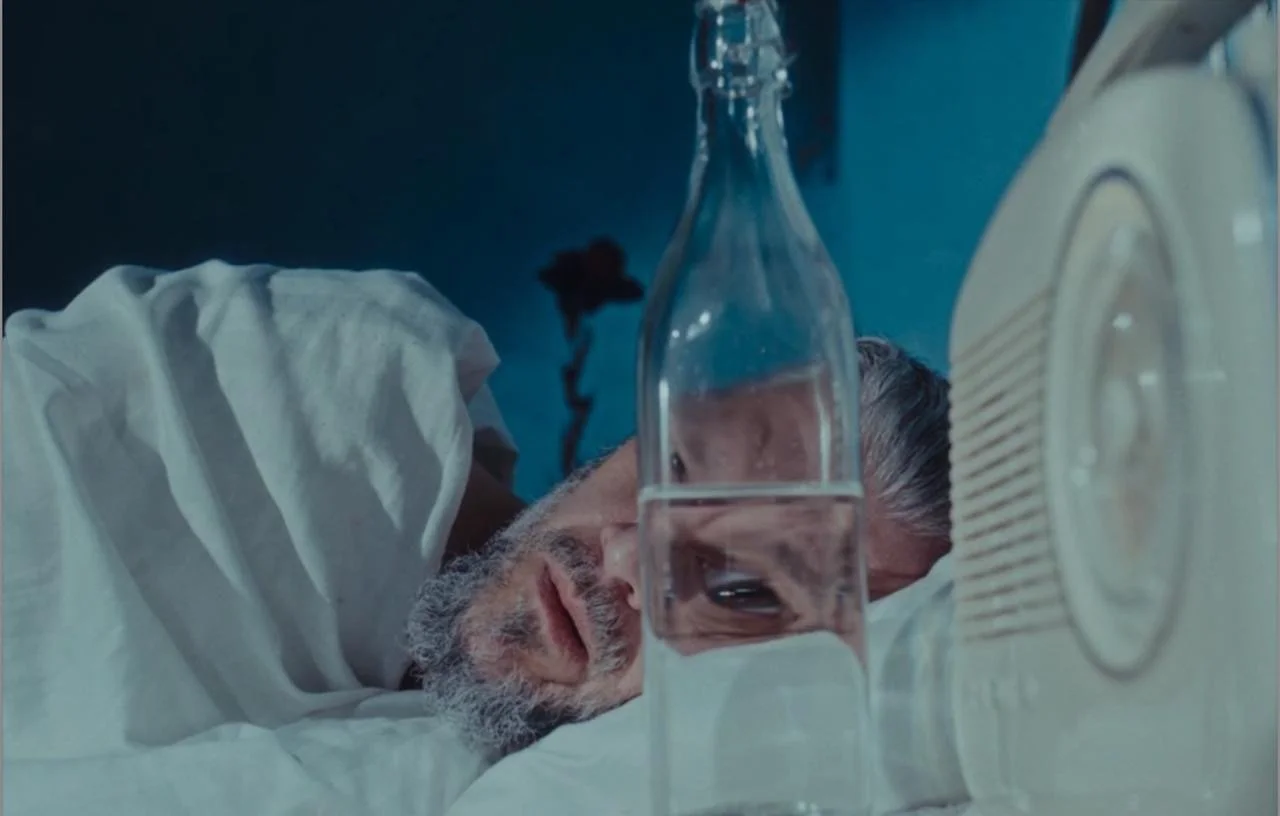
The project was called Seewetter, and the idea centred around an old fishing couple living in a very small house.
As the video continues, everything becomes more surreal and absurd, and eventually the couple is confronted with this almost catastrophic flood.
The room we filmed in was completely empty when we arrived. Everything you see in the final set came from what we selected in that warehouse.
That is something I find incredibly satisfying about set design. You walk into an empty room, bring all these individual objects into it, and suddenly it becomes a place with its own history and atmosphere.
Does it feel like you are creating a world for a story that already exists?
Definitely. That is why I sometimes describe set design as being a kind of midwife for a story.
The story already exists, but you help give it an aesthetic and physical form, and the two really depend on each other. A beautiful set cannot save a bad story, but at the same time, the way a space is designed can completely change how a story feels.
I think I have always had this desire to create worlds. Even as a child, I was imagining places and the people who might live inside them, and I still live quite strongly in fantasy worlds myself.
So there is something very natural about getting to do that as a profession, taking an empty space and asking, What could exist here?
What have you learned through all these different productions?
I think one of the biggest things I learned is how important it is to agree on a clear concept before you start.
That word, agree, is really important because all of this is such collaborative work. The clearer everyone is about the direction, the better the project becomes.
And from that comes probably an even bigger lesson: communication is everything. Good communication within a production makes such a huge difference, and I think that is something I have taken with me far beyond just this profession.
What would you tell someone who sees your work and thinks, “I would love to do that too”?
Take every opportunity you can in the beginning, and do not underestimate how important the social side is.
If you finish a production and people ask if you want to go for a drink afterwards, and you genuinely enjoy being around them, go. Not because you have to force yourself to network, but because relationships matter so much in this field.
I also think it helps to keep putting yourself into spaces where things are happening. I went to a lot of premieres, for example, and sometimes you might go somewhere alone and think, Am I trying too hard right now?
But I think you should not be embarrassed by that. If your passion brings you into a room, then be proud that you got yourself there.
You do not have to know exactly how to fill that space yet. Just being there, talking to people and staying open can lead to something, and when an opportunity comes, take it.
So there is also something about not being afraid to embarrass yourself a little?
Definitely. I think being afraid of looking too eager can stop you from doing so many things.
Sometimes you just have to show up. You might go to an event alone, introduce yourself to someone or ask if you can be part of something without knowing what will happen.
That can feel uncomfortable, but I would much rather follow something I am genuinely excited about than hold myself back because I am worried about how it looks.
And finally, what does motion mean to you
For me, motion is very connected to constantly moving toward something.
I have a very productive way of living, which is not always necessarily healthy, but there is usually some kind of vision that I am moving toward. And that means movement quite literally too, moving from one project to another, from one conversation to another, going outside, meeting people and experiencing things.
But I do not think motion should only be about work. It can also mean dancing, learning, following curiosity or simply doing things that make you feel alive.
For me, it is about staying open, staying curious and staying in motion.
Want to keep up with Alma? Below, you can find links to her projects and her social media.
