
Women in Motion Volume 17
Showcasing Designer Julia Verberne
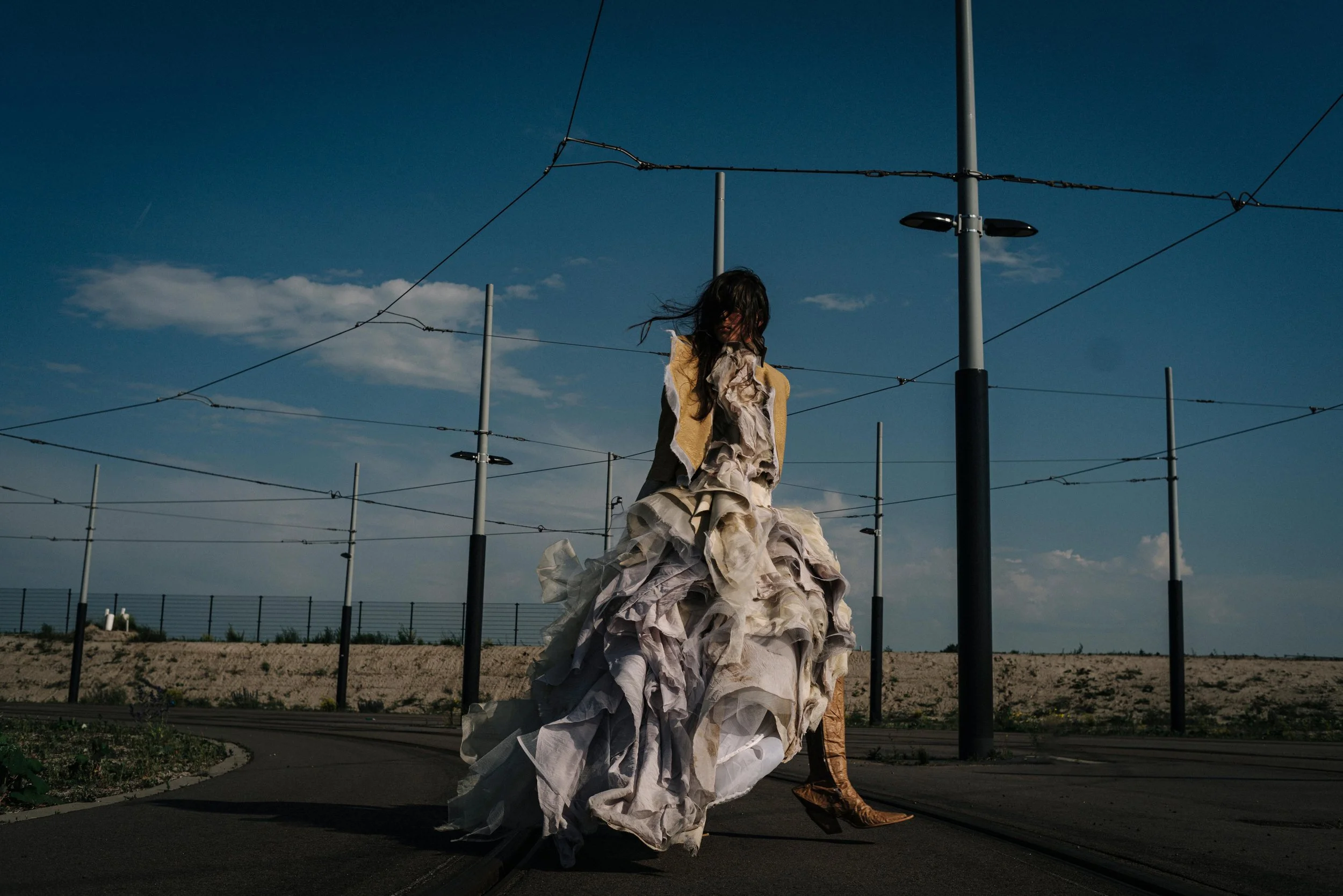
Julia Verberne’s collection was one of those rare encounters where I felt immediately drawn to someone’s way of seeing. I first saw her work at the Lichting show during Amsterdam Fashion Week, and I loved the women she imagined through her clothes: confident, soft, feminine, entirely themselves. There was such beauty in the faded colours and the way the fabric moved around their bodies. Watching them walk, almost floating, I felt drawn into a story before I knew anything about it.
Later, speaking with Julia, that story began to unfold. Her collection, Memoria Blanca, holds memories of her childhood in Nicaragua, the warmth of a breeze, and the rediscovered patterns of her grandmother’s wedding dress. Listening to how she works, I was struck by the care behind what I had seen. Even the smallest decisions belonged to the world she was creating. It made me appreciate her work even more, and want to understand the person whose way of seeing had brought it into being.
Where did your interest in creating begin?
I always liked making things. Drawing was a big part of that. I used to go to the zoo to sketch animals, so fashion wasn’t necessarily where I started. It came later, through exploring what I could do creatively.
My grandmother was an important inspiration. She had a clothing store, but apart from her, nobody in my family worked in fashion. It wasn’t something I had always known I would study. I found my way into it through making things and becoming curious about what else I could do.
When did fashion begin to feel like a possibility?
During a preparatory course at ArtEZ, we had an assignment where we draped materials directly on a model. It felt almost like sketching on the body.
At first, I thought I needed proper fabric. Then I started using whatever was around me, including rubbish bags. I could work quickly, put something on the body and react to what happened. I didn’t know much about making clothes yet, but I loved how freely I could explore.
I ended up making roughly twice the amount we were asked to. I wanted to keep going, so I did, without really thinking about where it might lead.
One of the teachers saw my work and told me I would be stupid not to apply to study fashion. That teacher is now the head of the fashion department at ArtEZ, although they weren’t at the time. I hadn’t really imagined that possibility for myself, so someone being that direct made me take it seriously.
How did it feel to enter a field that was still new to you?
I was insecure around people who already had technical knowledge. I had to learn how to make patterns, how to sew, how to turn an idea into a garment. There was a lot I didn’t know.
But that also became a strength. Because I didn’t know what was possible, I didn’t necessarily know what was supposed to be impossible either. I could imagine something and try to find a way to make it.
It took time to appreciate that. Learning the tools is one part of it. Understanding how your own brain works, and trusting what you bring through that, is another.
How do you develop an idea into a collection?
I start by imagining a world and trying to understand its feeling. From there, I can begin to make decisions about what belongs in it.
At ArtEZ, you’re constantly asked to question those decisions. Why this material? Why this shape? What are you trying to communicate? You have to understand the choices yourself, even when the starting point is quite intuitive. I also learned how to plan and give that process structure.
That thinking extends to everything around the clothes. We made a book alongside the collection, and even the paper needed to make sense within the same world. Its texture and the way it felt were part of how I wanted to communicate the work.
I like it when something feels pure and can stand on its own. There can be a lot of thinking behind a simple solution. Eventually, I want the work to carry the feeling without needing to explain every detail.
What is the story behind Memoria Blanca?
I spent part of my childhood in Nicaragua. It was an important place in my life, but over time it became somewhere I could mainly return to through memory.
I started thinking about what happens to a place when you remember it from a distance. Some things stay clear, while others become softer or change without you noticing. You can feel close to something that you can’t physically reach.
When I think of Nicaragua, I remember warmth and a soft breeze. That sense of air and movement became a starting point for the collection.
There is also the feeling of wanting to return to something familiar while knowing it won’t be exactly as you remember it. I wanted to explore that distance, and how those memories continue to influence the present.
How did those memories become garments?
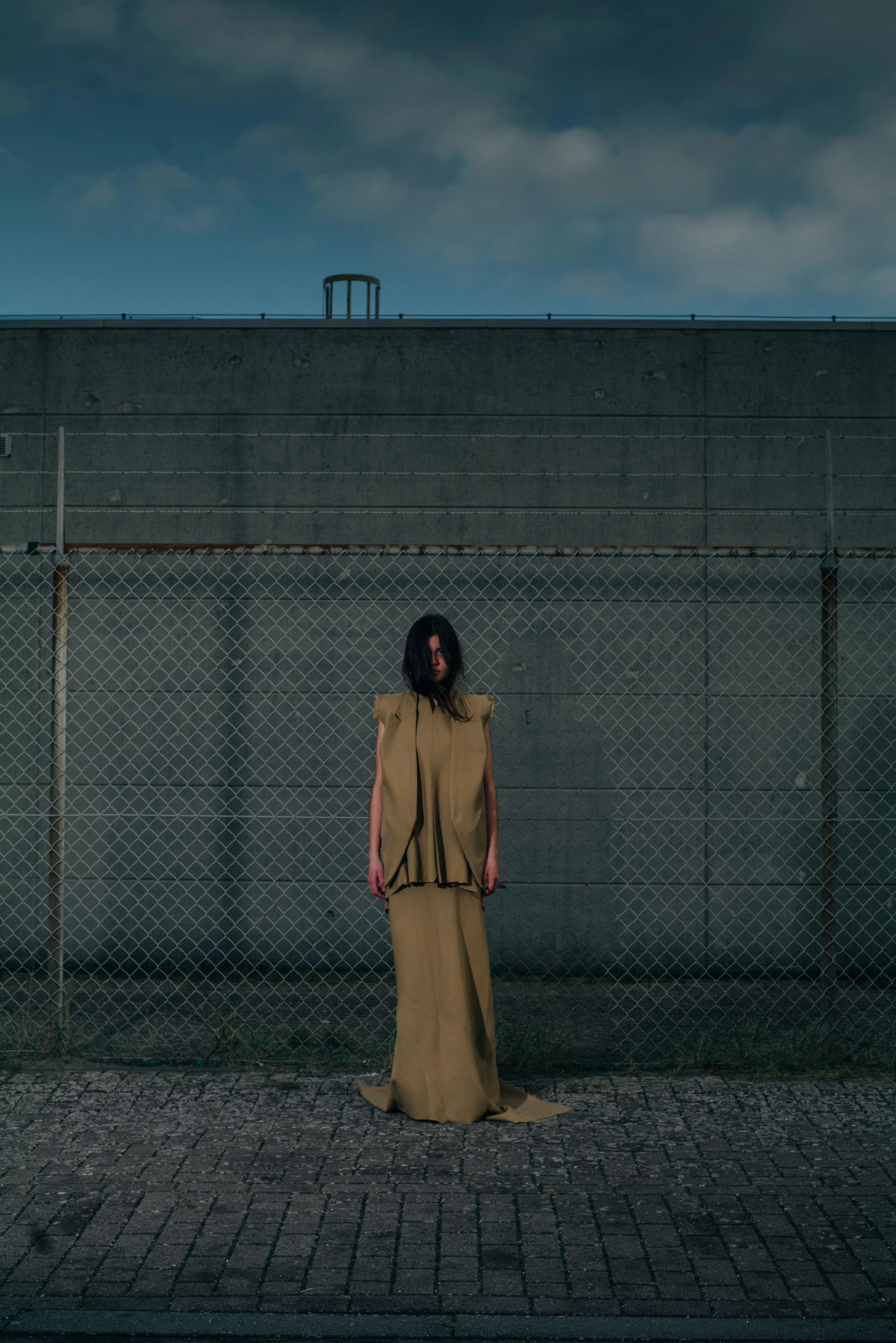
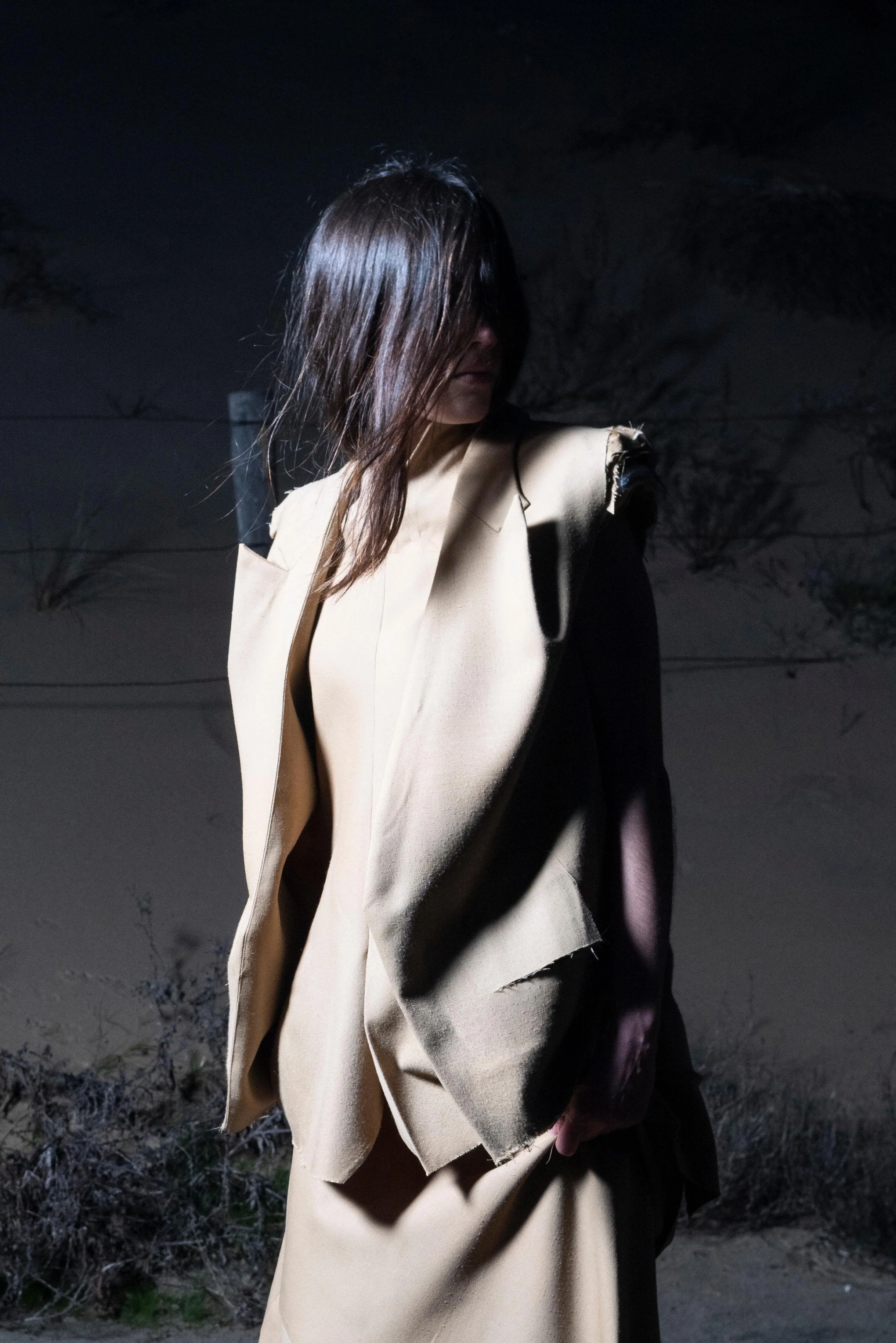
I worked by returning to the same patterns and changing how I used them. In the earlier collection, I worked from a classic blazer and the rediscovered pattern pieces of my grandmother’s wedding dress. For the graduation collection, the starting points also included a blouse and a skirt.
I shifted the grain, cut on the bias and altered the construction. A familiar shape could become something else while still holding a trace of where it began.
That repetition felt connected to remembering. You come back to the same thing, but your relationship with it changes. Through making, I could revisit those starting points and discover another version of them.
Wind was important in how I thought about the clothes on the body. I explored fabric moving towards or away from it, catching air, falling still or seeming to continue a movement. I wanted that feeling to exist in the construction itself.
What did working with your grandmother’s wedding dress bring into the process?
I had the pattern pieces, but I didn’t know exactly what the finished dress had looked like. There was space to imagine it.
Working with something from my family made the process emotional. Seeing traces of my aunt’s work connected what I was doing to someone who had worked on it before me.
A pattern or garment can already carry so much life. I’m interested in what happens when you take it into your own hands and give it another form. Something of the earlier version remains, but you bring yourself into it too.
How did you approach the textiles?
I wanted to explore traces, fading and the feeling of something that has changed over time. I worked with different treatments, including dyeing, washing, embroidery, needle punching and brushing the surface of fabrics.
For the flower prints, I gathered flowers from the street and used them to leave impressions on the material. I liked that the flower could disappear while something of it remained in the fabric. The textile holds its own memory of that process.
Different treatments gave each garment a particular character. I worked with hand-dyed silk and cotton, paper coating, and surfaces that changed through brushing or stitching. For the wedding-dress look shown at Lichting, I used deadstock fabrics.
The experimentation mattered because I couldn’t know everything in advance. I had to see how the material responded.
What inspires the atmosphere around your work?
Nature and films inspire me a lot. David Lynch was an important reference for how an image can create a feeling and stay with you.
I’m interested in that moment when you’ve seen something, but you’re left with an impression rather than a complete explanation. A person, a place or a small movement can do that.
In the photographs, we worked with a woman in deserted places, strong lighting, a car and flashes. I wanted the images to feel like a glimpse of someone that you keep returning to afterwards. That connected to the collection’s sense of memory and distance.
What were you exploring in your earlier Uniform B project?
It was a second-year project in which we had to develop a two-piece look. I was interested in what a uniform means to different people and how individuality can exist within it.
The B referred to Balenciaga. I researched how weight could influence construction and the way a garment falls. I also looked at Renaissance textiles, embroidery and floral motifs, which I translated into something more abstract.
The project involved a lot of hand embroidery and beadwork, with help during the production. After spending so much time on that kind of detailed work, I said I never wanted to use beads again.
It made me want to work more quickly and roughly afterwards. Sometimes that change in how you want to make things becomes part of the design.
What matters to you in the way you present women?
Women have been given so many expectations about how they should be. I think they should be able to express themselves in whatever way feels right to them.
Having the opportunity to show work is a privilege. I want to use that position to make room for different forms of expression.
I’m interested in the individual person within the clothes. Even when you begin with something familiar, like a uniform, the details can make it yours. There is something powerful in that freedom to decide how you want to present yourself.
What would you like to explore next?
I would like more experience collaborating with other people. I’m curious about how someone else’s thinking can interact with mine, and what we might discover through working together.
I’ve learned a lot through fashion, and I’m interested in how I can keep using those skills in different ways. I’m curious about what the next few years will bring.
What advice would you give to someone finding their own creative direction, or to your younger self?
Don’t be scared to be fully yourself. There are so many different ways of thinking. The way your mind works can bring something to a project that someone else wouldn’t have thought of.
It’s easy to see everyone’s work online and compare yourself. But everyone comes from a different environment and has followed a different path. What you make comes from your own combination of experiences, interests and ways of seeing.
I would tell myself to appreciate that sooner. Keep being curious about everything. You don’t always need to know immediately where an interest will lead.
What does “Women in Motion” mean to you?
Staying curious, continuing to explore and allowing yourself to express who you are.
I think it’s important that women have the freedom to move beyond expectations of how they should be. There should be room to discover your own way, and for that to keep developing.
For me, it also means letting your voice be heard. If you have the opportunity to express something, use it. Especially now, as a woman.
